Fashion
1. A J. Press men’s tuxedo shirt
Nominated by the New York-based designer Nili Lotan, 69.
“Tuxedo shirting is rooted in midcentury American men’s wear, and softer and more understated [than the classic white shirt, which dates to at least the early medieval period and has been endlessly tweaked and tailored since],” Lotan says. “I like the tension it holds: feminine in its ease and sensuality, masculine in its structure.”
2. An Esencia Maya guayabera
Nominated by the New York-based designer Stephanie Suberville, 40, a co-founder of the women’s wear brand Heirlome, which collaborates with Latin American artisans.
“In Mexico, where it’s often very hot, the guayabera, also known as the Yucatán shirt, is the proper attire for formal events like weddings,” says Suberville. “My dad wore them his whole life.” Thought to have originated in 18th-century Cuba, the shirt has two panels of tight pleats in the front and back and is often made of a lightweight fabric like linen and cotton.
3. A 45R Pima cotton shirt
Nominated by the New York-based designer Tory Burch, 59.
“My father [the investor Ira Earl Robinson] worked with a master shirt maker in Philadelphia to design his own shirts in the finest Pima cotton, always with unique details — from epaulets to the delicate embroideries he used in place of buttons,” says Burch. Known for its softness and durability, Pima cotton is named after the Indigenous group in Arizona that began producing it in the early 1900s. “The only new shirt that compares is from the Japanese brand 45R,” she says.
4. A Zanini cotton shirt with a round collar
Nominated by the South Korean-born creative director Sonya Park, 61, the founder of Arts & Science, a Japanese clothing and lifestyle brand.
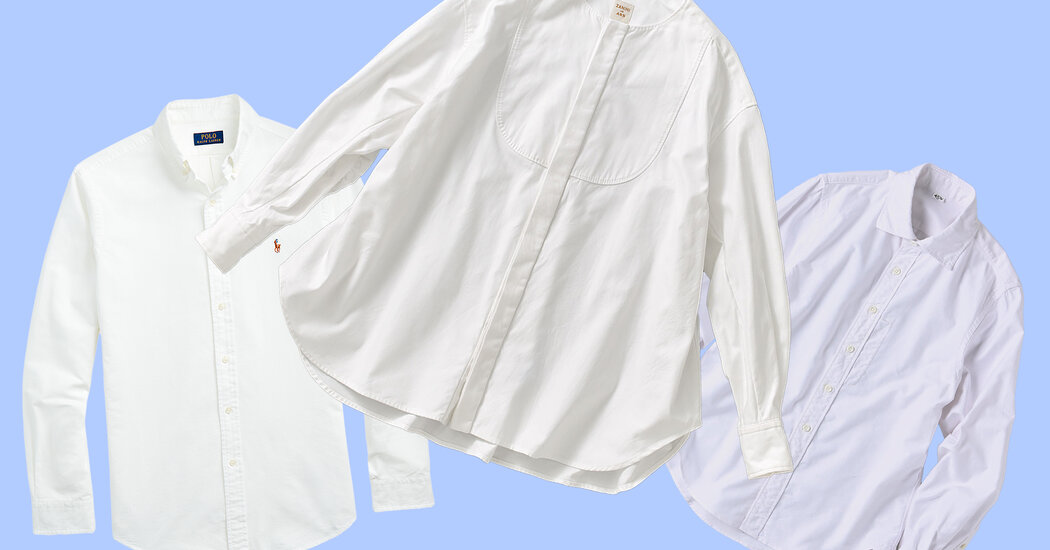
“The heaviness of the fabric and the details make this more than just a cotton shirt,” Park says of the Italian designer Marco Zanini’s creation. “It’s more like a blouse, with tuxedo shirt piqué bib details, side tuck pleats and hidden buttons that let me dress it up or down depending on the occasion.”
5. A Ralph Lauren oxford
Nominated by the New York-based designer Daniella Kallmeyer, 39, the founder of Kallmeyer.
The durability and comfort of oxford cotton, which originated in 19th-century Scottish mills and arrived in the U.S. in the 1890s, made the fabric an instant hit with men of the upper classes, who’d grown tired of the formality and stiff collars of the Victorian era. Lauren debuted his first women’s oxford shirt in 1971. “It’s a perfectly worn-in button-down in a heavy cotton that softens over time, with small frays at the seams,” says Kallmeyer.
6. A custom Finollo linen shirt
Nominated by the Italian designer Simone Bellotti, 47, the creative director of Jil Sander.
Aside from shirts from Charvet, the Parisian house founded in 1838 by Joseph-Christophe Charvet, Bellotti loves ones from “a tiny store called Finollo in Genoa [Italy],” he says. “It’s more than 100 years old, and beautifully preserved. They used to make shirts for [the industrialist] Gianni Agnelli. I had them make me one in linen, the original sustainable fabric, which was used by ancient Egyptians. Bellissimo.”
7. A Charvet pajama shirt and an Alaïa shirt with ruffles
Nominated by the Paris-based Italian jewelry designer Gaia Repossi, 40.
“The Egyptian-cotton pajama shirt I have from Charvet is the softest thing ever,” says Repossi. (Egyptian cotton, like Pima cotton, has extra-long staple fibers, making it stronger and softer than most.) “I don’t wear it to sleep — I wear it during the day. The other one is an Alaïa shirt by [the Belgian designer] Pieter Mulier. The one I have looks like what [the brand’s founder] Azzedine [Alaïa] was doing in the 1980s — but rethought, which is what a designer should do: advance a classic silhouette to make it look more modern. It has no collar and a shrunken waist, with little ruffles. It’s simple, with Belgian rigor.”
These interviews have been edited and condensed.
More in Fashion
See the rest of the issue