Recently, after a long weekend of glamping in the desert, my fiancé and I came home craving something light, something home-cooked, something with a vegetable. It turns out one cannot live off beef jerky and Cheez-Its alone.
When you need a reset — after travel, or anytime — it doesn’t hurt to go back to basics. What comes to mind right now is fish en papillote, truly one of the easiest and most foolproof preparations of cod, haddock or halibut — anything sturdy. Baked in tightly sealed parchment paper, or “en papillote,” the fish cooks gently and remains moist.
My favorite part is wrapping the little packages of fish, twisting the two paper ends closed like bonbons. The seal keeps the moisture in as the liquid turns to steam, which contains more energy than boiling water, and generates a lot of good heat in a tight space.
I first learned the en papillote technique from the food writer Rachel Khoo. Back in 2012, on her BBC cooking television show, “The Little Paris Kitchen,” she seasoned a whole trout with lemon and stuffed it with fennel slices, then wrapped it in parchment and baked it. The dish seemed too easy to mess up.
I had just graduated from college and was learning to fend for myself as a newly minted adult. At the time, I was living in Manhattan Valley, teaching at Columbia and shopping regularly at a grocery store that somehow always stocked whole brook trout. A busy class schedule kept my cooking projects at a minimum. So, when hosting dinner parties, I gravitated toward menu items that could be prepared in advance, like Ms. Khoo’s trout en papillote. I’d usually make the parcels the night before or the morning of dinner, and keep them in the refrigerator until my friends were a few drinks and a couple appetizers in, ready for the main show. All I’d have to do is heat the oven and pop in my little bonbons for about 20 minutes.
Wrapping the fish in parchment allows it to steam easily.Credit…Ghazalle Badiozamani for The New York Times. Food Stylist: Brett Regot.
The completed packages look a bit like wrapped candies.Credit…Ghazalle Badiozamani for The New York Times. Food Stylist: Brett Regot.
“The parcel does all the work for you,” Ms. Khoo said to me recently, “and that moment of opening it at the table is always a bit magical.” The showmanship of those parcels made my home feel like a restaurant.
Though many Asian cultures have been grilling or steaming foods in everything from banana leaves to clay for centuries, fish en papillote was popularized in France around the 17th century, making its way to haute cuisine restaurants. It then traveled to the United States, certainly by the 19th century, when Jules Alciatore of Antoine’s Restaurant in New Orleans wrapped pompano in parchment to honor Alberto Santos-Dumont, a famous aeronaut and hot air balloon designer who was visiting from Brazil. The paper, once baked, would balloon dramatically with hot steam.
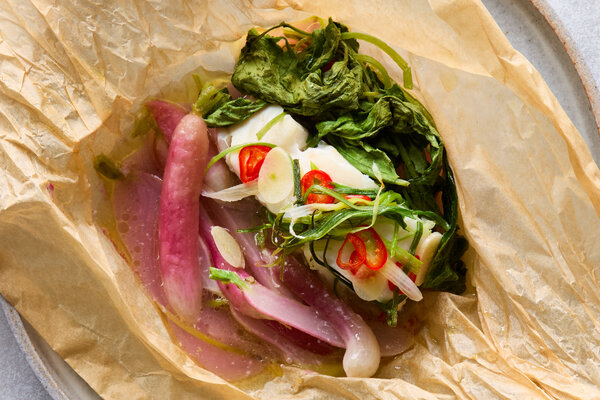
In my kitchen, over the next decade, the technique would remain the same, returning to my life whenever I needed to feed someone I loved or wanted to love, though its components might have changed. In this updated version, aromatic parcels of spoon-tender white fish fillets, sweet steamed radishes and peppery greens are a delight to unwrap. The fish itself is imbued with the dynamic flavors of fresh chile, garlic and scallions, plus a good smattering of salt to accentuate all those heady ingredients. In Korean cooking, radish often joins the party as a flavoring, something coaxingly bittersweet to balance the spicy, the savory, the oniony.
There’s a special kind of clarity that a cook can achieve with nary a searing, a browning or a caramelization. The real dream of this dish is the wholeness of the parcel, the way — as in a braise — the fish lends itself to the radishes and greens, and the radishes and greens lend themselves to the fish, in a flavor give-and-take.
As the parcel bakes, the radishes lend their pink juices to the broth that forms naturally from the fish and vegetables. The radishes themselves turn magenta, almost neon, and tender. A little butter adds richness. The aroma is killer, especially right as you open the package at the table, letting out a waft of hot steam.
Follow New York Times Cooking on Instagram, Facebook, YouTube, TikTok and Pinterest. Get regular updates from New York Times Cooking, with recipe suggestions, cooking tips and shopping advice.