Illicit labs are creating new synthetic drugs at breakneck speed. Dangerous, untested compounds are reaching users long before health agencies know they exist. Older drugs are regularly modified to create novel threats. Ecstasy is a prime example.
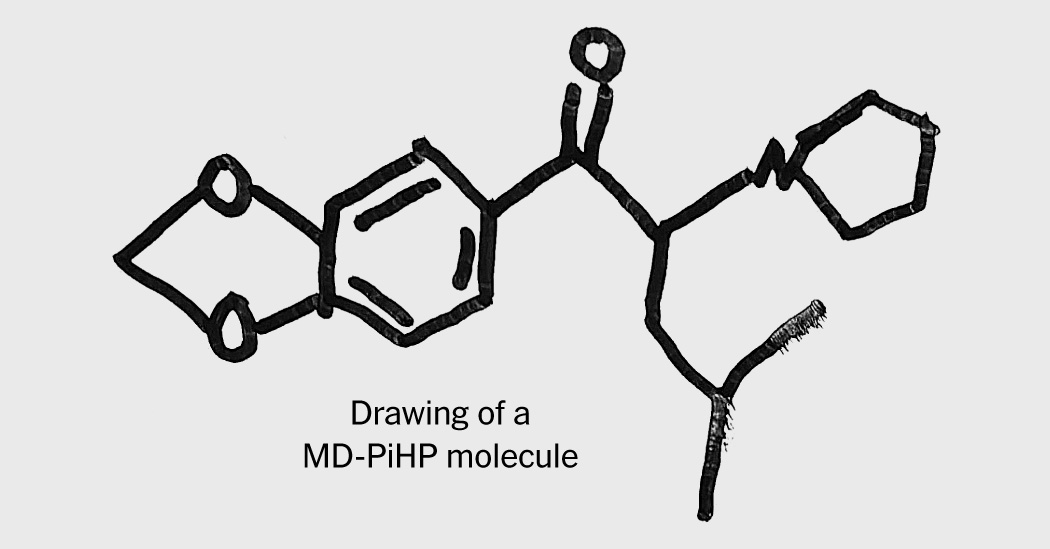
The party drug MDMA has been illegal since 1985. Its molecular structure can be drawn like this:
But what if you could add one atom to this molecule to change both the experience of taking the drug and its legal status?
You can. A single oxygen atom changes the molecule to methylone, which provides an Ecstasy-like euphoria.
This simple change had a profound consequence. When methylone reached the U.S. market in 2010 the drug could be sold legally in corner stores and smoke shops as “bath salts.”
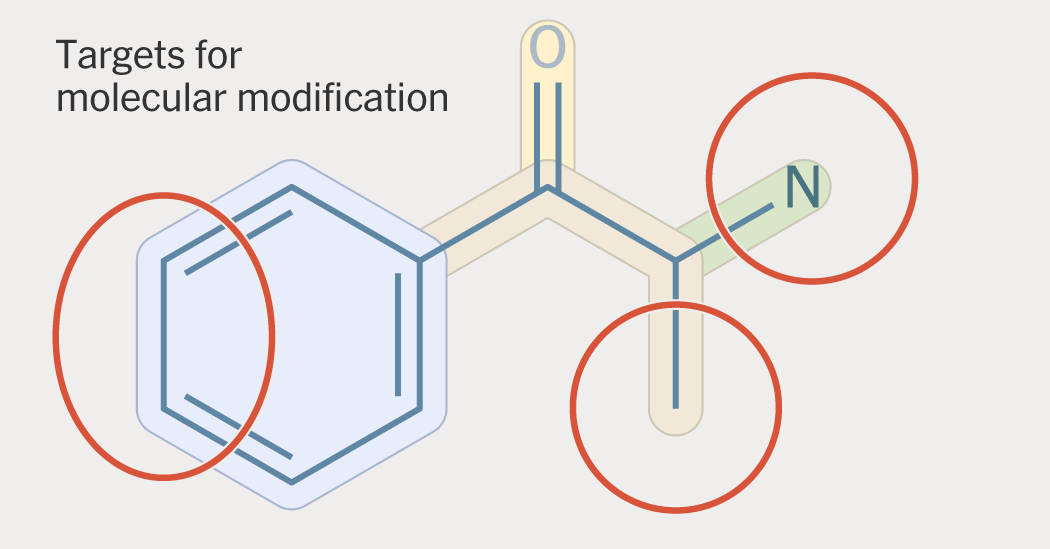
But methylone wasn’t the end of the story. Illicit chemists now use methylone’s structure as a template for modern-day alchemy. New drug laws push them to invent new variants, which emerge in the illicit drug market with untested potencies and effects — a vicious cycle that has been impossible to contain.
These chemists are located in unregulated labs around the globe, from big enterprises in China and India that produce drugs and their precursor compounds in huge volumes, to single-person and small domestic operations that cut and package drugs for retail sale. Some of the most-used drugs, such as fentanyl, are mixed in Mexico and exported north.
Waves of Bath Salts
Methylone was an early example of a class of drugs known as synthetic cathinones, which continue to proliferate.
Beginning in 2010, emergency rooms began seeing agitated patients who were violent, paranoid and psychotic after ingesting synthetic cathinones sold as bath salts. Poison control centers received a few hundred calls about the drugs in 2010. The following year had over 6,000 calls.
When methylone was finally banned in 2011, unregulated chemists simply tweaked the molecule to evade the ban, creating new drug formulas. The Drug Enforcement Administration noted in 2019 that “as one synthetic cathinone is controlled, another unscheduled synthetic cathinone appears in the recreational drug market.”
Examining the drug on a molecular level shows how illicit chemists try to increase potency and heighten the effect in a user’s brain.
As cathinone molecules become more potent, they also become more addictive. “Because they hijack the dopamine system in the brain — the salience and reward system in the brain — they’re going to be extremely addictive,” said Dr. Michael Baumann, director of the Designer Drug Research Unit of the National Institute on Drug Abuse. “There’s a reason why chemists would design these.”
Experts confirmed that the molecules described in this article are well known among illicit chemists, who have moved on to newer structures. “These are not rudimentary chemists,” Dr. Baumann said. “They’re actually ahead of us.”
Nitazenes, the ‘Frankenstein Opioids’
Another class of drugs has been following a similar pattern. When China banned all variants of fentanyl in 2019, illicit chemists began to research non-fentanyl opioids and rediscovered nitazenes, drugs developed in the 1950s as alternatives to morphine but never approved for medical use. Chemists modify the molecules — which are more complex than cathinones — in similar ways to increase potency.
“This is trial and error,” said Dr. Alex Krotulski, director of the Center for Forensic Science Research and Education, of the efforts. “They’re pushing the envelope to make more and more potent drugs.”
By the end of 2024, at least 22 nitazene molecules had been identified. New variants are prized because of their inexpensive production costs, high potency and vague legal status, according to a 2023 paper.
Ohio’s attorney general was referring to nitazenes when he warned that “Frankenstein opioids are even more lethal than the drugs already responsible for so many overdose deaths.”
China banned nitazenes in July 2025, a move that may cause production to shift to other countries. In the meantime, illicit chemists searching through patents and research papers may stumble on another class of legal molecules to tweak and modify.
“It’s so much more dangerous today, the drugs are so much more potent,” said George W. Hime, assistant director of toxicology at the Miami-Dade Medical Examiner. “Someone out there is playing chemistry.”