Theater
What defines avant-garde theater is as nebulous as its origin story, but most scholars point to 19th-century France, when a growing restlessness for social reform led to more provocative types of artistic expression. The term, as applied to the arts, came from the French philosopher Claude Henri de Saint-Simon, who in 1824 encouraged artists to be the avant-garde (or front line), to generate new ideas and advocate for change. By the late 1800s, theater companies across Europe were upending tradition, using their medium to critique mainstream culture and offer their audiences original and contemplative performances.
The wave of artists, musicians and writers leaving Europe in the 1930s and ’40s brought the same anti-establishment spirit to American stages, influencing the next generation of playwrights. By the 1960s, the country’s theater scene had become increasingly experimental — in what the theater historian Arnold Aronson has called “the utter rejection of the status quo” — notably in downtown Manhattan, with pieces like the Performance Group’s “Dionysus in ’69” (1968), directed by Richard Schechner and first performed in a SoHo garage with a mostly nude cast. Over time, much of nontraditional theater came to be defined as avant-garde but, for the New York playwright Jackie Sibblies Drury, 44, the German director Thomas Ostermeier, 57, and the Belgian director Ivo van Hove, 67, the genre’s most successful productions adhere to Saint-Simon’s original intent: They’re works that changed not only the medium but audiences too.
‘Julius Caesar’ (circa 1599) by William Shakespeare, as performed by the Meiningen Company in 1881
An acting troupe founded in central Germany in 1866, the Meiningen Company performed German and British classics — including Shakespeare’s “Julius Caesar,” at the Drury Lane theater in London — “but they were groundbreaking when it comes to big choreography onstage,” says Ostermeier. “They kind of invented 20th-century regietheater, or director’s theater, which gave directors creative freedom. They were also the avant-garde for what became naturalism — more realistic sets, costumes and acting methods that inspired the Russian director Konstantin Stanislavski.”
‘Hedda Gabler’ (1891) by Henrik Ibsen
“It must’ve been a real avant-garde piece at its time, as it talks about the position of women in society,” says van Hove. “After 135 years, it still resonates.”
‘Point Judith (An Epilog)’ (1979-82) by Elizabeth LeCompte and Spalding Gray
“One of my early life-changing experiences in the theater was ‘Point Judith,’ by New York’s Wooster Group, which I saw in a Brussels festival in the early ’80s,” says van Hove. “It was the first time I saw a radical interpretation of Eugene O’Neill’s ‘Long Day’s Journey Into Night’ using multimedia.”
‘Imperceptible Mutabilities in the Third Kingdom’ (1989) by Suzan-Lori Parks
After seeing Parks’s early work, especially this one, Drury recalls thinking, “I’m not exactly sure that I understand this, and I also completely, fully understand it.” The characters felt like they were “in this weird dreamscape about being African American,” she says, “and having this constant nightmare of the trans-Atlantic passage as a part of their everyday reality.
‘The Law of Remains’ (1992) by Reza Abdoh
“Abdoh was American of Iranian descent and was famous in the late ’80s and early ’90s in New York and Los Angeles,” says Ostermeier. “ ‘The Law of Remains’ was very physical and very crazy in a good sense, with actors playing the serial killer Jeffrey Dahmer and the artist Andy Warhol. Though he was a wunderkind of the American theater, he had a very short career because he died of complications from AIDS in the ’90s. He’s almost completely forgotten now, but his shows are online.”
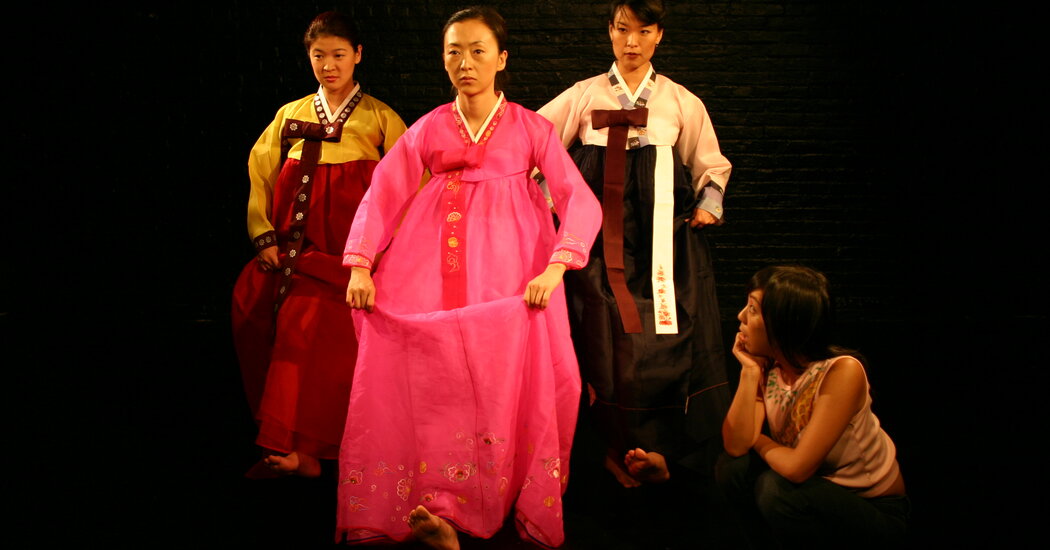
‘Songs of the Dragons Flying to Heaven’ (2006) by Young Jean Lee
“It’s so explosive and angry, funny and dark — and plays with Korean American identity in a way that no one else was doing at that time and maybe still isn’t,” says Drury. “A mix of scenes, monologues and dance, it was one of my introductions to experimental theater.”
‘Story of the Eye’ (2022) by Janaina Leite
“Leite, a Brazilian playwright, is what we call a geheimtipp (‘insiders’ tip’ in German),” says Ostermeier. “She’s not yet on the map of big institutions. Her adaptation of the French writer Georges Bataille’s novel ‘Story of the Eye’ (1928) is about performers who’ve had a life in the porn industry or in sex work, each taking a chapter from Bataille’s book and talking about how it connects to their own experiences.”
These interviews have been edited and condensed.
More in Theater
See the rest of the issue