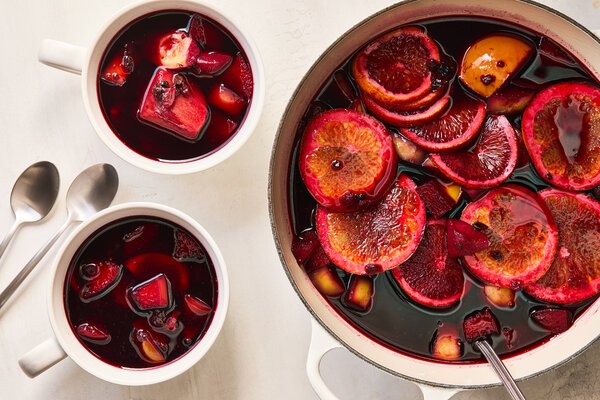
Ponche Navideño merges holiday spice with tropical fruit to make one of the season’s most festive sippers.
The instant the door to a posada swings open, the scent of ponche Navideño finds its way out first: warm spices rising over bright citrus, piloncillo melting into burned honey sweetness, mingled with the sour notes of dried hibiscus and the soft aroma of poached ripe fruit. Posadas, holiday parties in Mexico and its diaspora, traditionally run Dec. 16 to 24, but the fragrant, steaming elixir known as ponche Navideño is poured into thick clay mugs from the first chilly day of the month until the roscas de reyes (three kings bread) appears on Jan. 6.
As complex as ponche tastes, it’s simple to put together as a welcome, warming drink for a crowd. The base starts with a tea of spices and hibiscus flowers that stain the ponche crimson. Dried fruit like prunes or raisins then infuse it with depth, along with piloncillo, an unrefined cane sugar. With this irresistible foundation, the classic version will appeal to anyone, but is especially meaningful to those who grew up sipping it.
As the chef Ricardo Muñoz Zurita writes in the great archive of Mexican cuisine, “Larousse Diccionario Enciclopédico de la Gastronomía Mexicana,” the drink’s lineage began in ancient Persia as “panch,” a rose-scented fruit punch with pomegranate, lime and orange blossom water. It traveled on colonial ships, becoming Spanish ponche before landing in New Spain. Once in Mexico, it leaned on the generosity of the tropics with the addition of pineapple, plump guavas, fresh sugar cane, tamarind pods and, the most treasured fruit of all, tejocotes. The small Mexican hawthorn fruits, faintly astringent and grainy like a crunchy pear, are prized for their dense yet creamy bite when cooked.
In Tijuana, Mexico, the chef José Figueroa highlights the classic taste with local ingredients like heirloom red-and-yellow apples from Valle de Guadalupe and dried figs from Mexicali. At his restaurant Carmelita Molino y Cocina, he serves it ice-cold and effervescent as ponche soda with a fermented ginger starter, sometimes spiked with Joto Juan, an elegant liqueur distilled from century-old orange trees. In this iteration, sweet brightens into bitter, bitter softens into sweet. The ponche feels entirely new yet it still is unmistakably rooted.
Farther down the coast in Ensenada, Shava Cueva, the author of “Bebidas de Oaxaca,” still tastes his childhood in every jarrito (clay mug). For him, ponche carries echoes of the fizzy, fermented tepache de frutos that Don René Sánchez Ramírez makes in Oaxaca. Ponche, by contrast, is more mellow since it’s simmered over the stove and served piping hot the moment it’s ready, like the most generous tea.
In Los Angeles, the chef Fátima Juárez of Komal at Mercado La Paloma carries that same warmth across the border. While growing up in Mexico City, Ms. Juárez and her family made an enormous pot that perfumed their entire house every December. When she moved to L.A., the ritual slipped away yet the memory stayed with her: the bite of the small, porous yellow apples that swell with the scents of cinnamon, hibiscus, guava and clove until they practically burst with flavor.
For Ms. Juárez, ponche is the taste of “cooking according to what we used to do in Mexico.” This holiday season, she is hosting her family in Los Angeles for the first time and will simmer the ponche in a massive olla on her stove. As she stirs the pot, she’ll think of her father, who died last month, and the scent filling her home will be a quiet way to grieve and keep him present.
Mr. Cueva said that this form of fruit resting in liquid tastes like Christmas itself. Whether you hold deep memories of ponche or have never tasted it, its aroma is transporting. One sip, and you are home.
Follow New York Times Cooking on Instagram, Facebook, YouTube, TikTok and Pinterest. Get regular updates from New York Times Cooking, with recipe suggestions, cooking tips and shopping advice.